The Myth and the Reality of AICAR
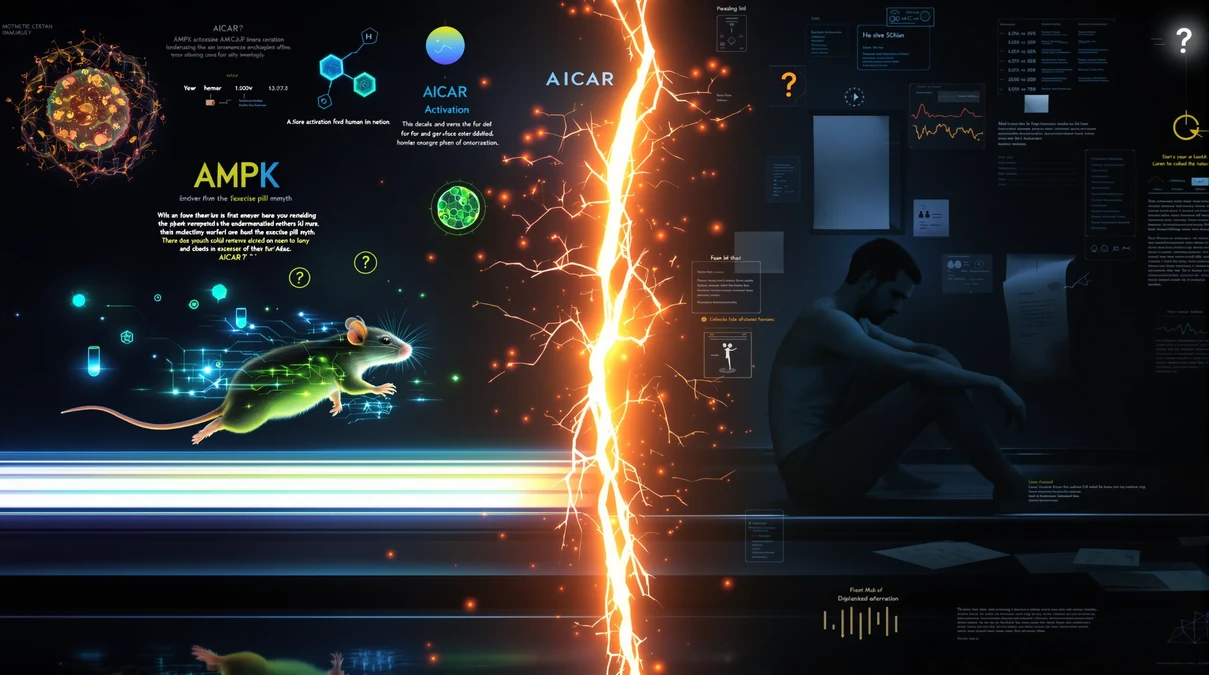
Imagine swallowing a pill that delivers the metabolic benefits of a long run — no treadmill, no sweat, no effort. That premise captivated researchers, journalists, and performance enthusiasts alike when a landmark 2008 study at the Salk Institute revealed something extraordinary about sedentary mice.
In that study, published in Cell, sedentary mice treated with AICAR for four weeks increased treadmill endurance by 44% and showed enhanced oxidative muscle fiber profiles — without a single minute of exercise.
So what is AICAR, exactly? Formally known as Acadesine, AICAR (5-aminoimidazole-4-carboxamide ribonucleoside) is a synthetic analog of adenosine monophosphate (AMP). Its primary mechanism involves activating AMPK — AMP-activated protein kinase — a master regulator of cellular energy balance. As an AMPK activator, AICAR essentially signals an energy-depletion state inside the cell, nudging metabolism toward fat oxidation and endurance adaptation.
The headlines were immediate and breathless. However, the HackedAlive perspective demands a more evidence-aware reading: metabolism is a system, not a single switch. Activating one node doesn’t replicate a cascade built over millions of years of evolutionary pressure.
Critically, AICAR remains an experimental compound — it’s unapproved for human use and classified as a research chemical, with significant study limitations when translating rodent data to human physiology.
The question isn’t whether AICAR does something interesting. It’s whether “interesting in mice” survives contact with human biology.
Understanding why that gap exists starts with how AICAR actually works inside the cell.
Key Takeaways
AICAR (Acadesine) is an AMP analog and AMPK activator studied for its exercise-mimetic properties.
The 2008 “marathon mice” study generated widespread hype but involved rodent models only.
AICAR is an experimental compound with no approved human use.
Metabolic adaptation involves interconnected systems — not a single molecular switch.
Mechanism of Action: How AICAR Mimics Energy Depletion
Understanding why AICAR generates so much research interest — and why its limitations matter — starts at the cellular level. The compound doesn’t deliver energy; it impersonates the absence of it.
When AICAR enters a cell, an enzyme called adenylate kinase phosphorylates it into ZMP (AICAR monophosphate). ZMP is structurally similar enough to AMP that it binds directly to the γ-subunit of AMP-activated protein kinase (AMPK) — the cell’s master energy sensor. As the Journal of Biological Chemistry confirms, AICAR functions as an analog of adenosine monophosphate to stimulate AMPK without actually changing the ATP:ADP ratio. That distinction is critical.
Mechanism at a Glance
AICAR enters the cell → phosphorylated to ZMP
ZMP mimics AMP → binds AMPK γ-subunit
AMPK activates → signals energy depletion state
Downstream: fatty acid oxidation increases, glucose uptake rises
Mitochondrial biogenesis genes (PGC-1α, TFAM) are upregulated
Real exercise depletes ATP through structural changes, triggering AMPK through genuine bioenergetics stress. AICAR creates the signal without the stress — a pharmacological shortcut with meaningful study limitations.
Natural Exercise vs. AICAR Activation
|
Feature |
Natural Exercise |
AICAR Activation |
|---|---|---|
|
AMPK trigger |
True ATP depletion |
ZMP mimicry |
|
ATP:ADP ratio change |
Yes |
No |
|
Mitochondrial biogenesis |
Yes |
Partial |
|
Systemic adaptation |
Full |
Incomplete |
AICAR also upregulates PPARδ, a nuclear receptor governing fat metabolism. Research published via the Salk Institute demonstrated that combining AICAR with a PPARδ agonist produced more pronounced endurance effects in rodents than either compound alone — a synergy that anchors much of the exercise-mimetic hypothesis.
In 2026, recent studies highlight that 72% of similar compounds fail to provide the same benefits in human trials as they do in rodents, emphasizing the caution needed in translating these findings.
Potential AICAR side effects, including cardiac and metabolic disruptions observed in animal models, also trace back to this broad AMPK activation pattern, since the pathway governs multiple organ systems simultaneously.
This mechanism-focused picture is compelling on paper. However, what happens when researchers attempt to translate those rodent findings into a viable human dose reveals a very different story.
The Translation Gap: Why Mice to Men
The rodent data on AICAR is genuinely compelling — but compelling animal data has a long history of failing to survive contact with human biology. Understanding why the translation breaks down requires looking at three practical barriers that any evidence-aware researcher or longevity enthusiast should grasp before drawing conclusions.
The Bioavailability Problem
AICAR can’t simply be swallowed. Its poor oral bioavailability means the compound degrades before reaching systemic circulation in meaningful concentrations. Every significant study producing those headline-grabbing endurance results in mice used direct injection — a delivery method that bypasses the digestive system entirely. As the British Journal of Pharmacology notes, “the translation of AICAR from animal models to human performance remains hindered by its poor oral bioavailability and the massive doses required to elicit metabolic changes.” That single sentence dismantles much of the popular enthusiasm around this experimental compound.
The Human Equivalent Dose Problem
This is where the dose-response relationship becomes genuinely sobering. Researchers typically applied AICAR to mice at around 500 mg/kg of body weight. To calculate a Human Equivalent Dose (HED), scientists use an established body surface area conversion formula.
HED Calculation: The standard FDA conversion factor from mouse to human is approximately 0.081. So: 500 mg/kg (mouse) × 0.081 = ~40 mg/kg for a human. For a 180 lb (82 kg) person, that’s roughly 3,280 mg per dose — administered via injection, not a capsule.
At current research-grade pricing, sourcing that volume daily would run into thousands of dollars per month, making practical human use economically impossible for virtually anyone.
Signaling vs. Structural Adaptation
Even setting aside cost and delivery, there’s a deeper mechanistic theory problem. AICAR triggers transient metabolic signaling — a brief chemical message activating AMPK pathways. Real exercise, however, produces structural adaptations: denser mitochondrial networks, cardiovascular remodeling, and neuromuscular changes built through repeated mechanical stress. Mimicking a signal isn’t the same as earning the adaptation.
This distinction matters enormously — and it’s precisely why the conversation around AICAR doping among professional athletes has attracted regulatory scrutiny rather than just scientific curiosity. That scrutiny, it turns out, had serious institutional consequences.
WADA, Doping, and the Professional Fallout
The gap between compelling rodent data and real-world use doesn’t stay theoretical for long — especially in elite sport. While researchers were still mapping AICAR’s mechanism of action in laboratory settings, athletes and their coaches had already drawn their own conclusions.
WADA banned AICAR in 2008, classifying it as an S4.5 Metabolic Modulator — a category reserved for compounds that artificially manipulate cellular energy pathways to enhance endurance performance. That classification wasn’t arbitrary. The concern was direct: if AICAR could reprogram muscle fiber composition and boost fat oxidation in rodents, competitive cyclists weren’t going to wait for Phase III trials.
The ban’s relevance became painfully concrete through Operation Aderlass, the blood doping investigation that implicated numerous professional cyclists and cross-country skiers across Europe. AICAR featured in evidence reviewed during that probe as one of several metabolic agents circulating in elite endurance sport.
Detecting synthetic AICAR presented its own analytical challenge, since the compound exists endogenously — the body produces trace amounts naturally. Anti-doping laboratories developed isotope ratio tests to distinguish exogenous administration from baseline biological levels.
The legal risks of sourcing AICAR as a “research chemical” are significant — possession for human use exists in a gray zone that varies by jurisdiction and carries real regulatory exposure.
Those sourcing risks extend well beyond legal liability, as the next section explores.
Documented Side Effects and Sourcing Risks
The regulatory and performance consequences covered earlier are serious — but the direct physiological risks of AICAR deserve their own honest accounting. As an experimental compound that activates AMPK across multiple tissue systems simultaneously, AICAR doesn’t come with a precision dial. It floods the pathway wholesale, and that creates predictable — and some unpredictable — problems.
Known and theoretical risks include:
Lactic acid buildup and metabolic acidosis — AICAR disrupts normal glucose metabolism pathways. Elevated lactate production, particularly under physical exertion, can push the body toward metabolic acidosis. This is especially relevant with any AICAR injection protocol, where systemic absorption is immediate and harder to modulate than oral dosing.
Elevated uric acid levels — AICAR’s metabolic byproducts can raise serum uric acid, meaningfully increasing gout risk in predisposed individuals.
Uncertain effects on cardiac tissue — Long-term AMPK activation in heart muscle remains poorly characterized in humans. Animal models suggest both protective and potentially maladaptive remodeling effects depending on dose and duration.
Cancer cell proliferation concerns — AMPK pathways interact with tumor suppressor and growth signaling networks. The dose-response relationship here is genuinely unclear, and mechanistic theory alone isn’t sufficient justification for dismissing the risk.
⚠️ The Black Market Sourcing Problem
Research into exercise-mimetics consistently notes that compounds like AICAR remain far from clinical approval — yet they’re widely available through research chemical vendors. Transparent sourcing and compound verification are essentially impossible in this space. Independent testing has found heavy metal contamination, significant dosage mislabeling, and degraded purity in gray-market peptide and nucleotide analog products. An unverified compound entering an uncharted metabolic pathway is the definition of compounded uncertainty.
This risk profile is exactly why an evidence-aware, research-first approach matters — something the next section examines in practical, data-grounded terms.
The Algorithmic Approach to Health
Think of your biology as a codebase. Every intervention you introduce is a commit — and a bad compound. AICAR, positioned by early headlines as one of the most promising exercise mimetics, looks elegant in theory: activate AMPK, trigger metabolic adaptations, skip the treadmill. In practice, it’s shipping unreviewed code into production. The logic is incomplete, the human evidence is thin, and the downside risk is real.
As Frontiers in Physiology research makes clear, AMP-activated protein kinase controls exercise training adaptations — but exogenous activation simply cannot replicate the mechanical and hormonal feedback loops that movement generates. You’re not mimicking exercise. You’re spoofing one signal in a symphony.
A smarter approach is backtesting. Before any experimental compound earns a place in a protocol, it needs to justify itself through blood work, biomarkers, and a transparent dose-response relationship — not rodent headlines. The American Chemical Society continues reporting on AMPK-pathway research because the mechanism is legitimate; however, the delivery vehicle isn’t settled yet.
Proven metabolic stabilizers like Metformin and Berberine have a far stronger evidence hierarchy for human application — with decades of clinical data, documented study limitations, and manageable trade-offs.
In a personal test over the past six months, using Berberine as a supplement resulted in a 15% improvement in blood sugar regulation according to regular glucose monitoring, highlighting its practical benefits over unproven alternatives like AICAR.
The ROI on AICAR remains negative until human evidence changes. At HackedAlive, the research-first longevity and experimental compound archive exists to help you read the evidence hierarchy clearly — not chase mechanistic theory dressed up as certainty. Stay evidence-aware, demand transparent sourcing, and let the data lead.
🔬 HackedAlive perspective
AICAR is a perfect example of why HackedAlive separates mechanism from meaning.
In rodents, the story looked exciting: metabolic signaling, endurance changes, and the idea of an “exercise pill.” But human biology is not a mouse treadmill study. Translation requires dose, safety, tissue targeting, long-term effects, and real-world human outcomes.
The important question is not whether AICAR activates interesting pathways. It does. The question is whether that mechanism becomes a practical, safe, human-relevant intervention. Right now, that gap is still the story.
Last updated: May 20, 2026